Douglas: Unearthing the Power of Ancient Craftsmanship
Some design projects demand more than just a typeface; they demand a presence, a weight, a story etched into every letterform. If you're crafting a world steeped in lore, building a brand with a soul forged in history, or designing a logo that needs to feel both timeless and imposing, the search for the perfect font can feel like an archaeological dig. You're not just looking for letters—you're hunting for an artifact. This is the precise space where the Douglas typeface emerges, not as a simple font, but as a tool for visual world-building, channeling the raw power of ancient craftsmanship into modern design.
A Typeface Forged in Legend
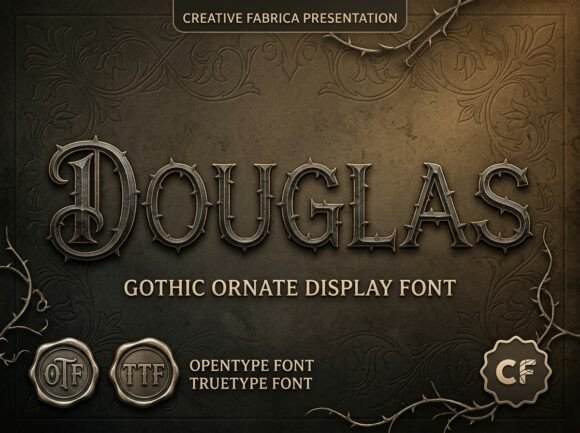
Douglas is a premier gothic ornate display font, but that description barely scratches the surface. Its character is defined by sharp, thorn-like terminals and a deeply weathered, chiseled stone texture that gives it an immediate sense of history and gravitas. Imagine the intricate metalwork on a medieval gauntlet or the carved stone archway of a forgotten cathedral—Douglas captures that visual language. It speaks of high-fantasy heraldry, of kingdoms and quests, of secrets locked in iron and oak.
What prevents this powerful aesthetic from becoming overly aggressive or one-note is its subtle "thistle and vine" aesthetic. Woven into its architectural strength is an organic, almost botanical grace. This duality is its genius: it communicates both indestructible power and a deep, living history. It’s a typeface that feels like it has been unearthed, not designed, making it an unparalleled asset for projects that need to convey heritage, mystery, and a commanding "dark-luxe" soul.
Where the Douglas Typeface Commands Attention
The true test of a premium font is its versatility within its niche. Douglas isn't for your grocery list or a corporate memo. It’s a specialized tool designed for high-impact, narrative-driven applications where mood is paramount.
- Logo & Brand Identity: For a craft brewery, a bespoke leather goods shop, a specialty coffee roaster, or an independent game studio, Douglas can form the cornerstone of a powerful brand identity. It immediately sets a tone of quality, tradition, and artisanal care.
- Publishing & Editorial Design: Think beyond the book cover. Douglas is perfect for fantasy novel titles, chapter headings, and drop caps that pull a reader into another world. It can also elevate editorial layouts for magazines focused on history, craftsmanship, or outdoor adventure.
- Digital & Entertainment: This is where Douglas truly shines. Use it for high-stakes gaming logos, cinematic title sequences, podcast artwork, or YouTube channel branding for content about mythology, lore, or tabletop RPGs. It makes an immediate visual promise to your audience.
- Packaging & Merchandise: Imagine Douglas on the label of a small-batch whiskey, the packaging for a artisan chocolate bar, or the front of a premium t-shirt for a music festival. It transforms a product into a story, adding perceived value and a distinct shelf presence.
- Events & Invitations: For a themed wedding, a historical reenactment, a Halloween event, or even a milestone birthday with a "medieval feast" theme, Douglas sets an unforgettable tone from the first glance at the invitation.
Practical Wisdom for Using a Bold Display Font
Integrating a typeface as distinctive as Douglas into your design toolkit requires a thoughtful approach. Its power lies in its specificity, and using it effectively means understanding a few key principles of modern typography and brand strategy.
Pair with Purpose: A display font like Douglas should rarely stand alone for body text. Its strength is in headlines and logos. Pair it with a clean, highly readable sans-serif font (like a modern grotesque or a geometric sans) or a simple, elegant serif for longer passages. The contrast creates hierarchy and ensures your message is both beautiful and legible. Test pairings extensively to see how the fonts converse.
Mind the Context: Always ask: does this font's personality align with my project's goals? Douglas communicates heritage, strength, and mystery. Using it for a children's toy brand or a minimalist tech startup would create a jarring disconnect. Its power is in its alignment with a specific narrative—use it where that narrative is needed.
Readability is Non-Negotiable: As a display font, Douglas is optimized for impact at larger sizes. Avoid using it for small, lengthy paragraphs where its intricate details can become lost and hinder reading ease. Its purpose is to arrest attention, not to facilitate a long read. Always review the full character set, including numbers and punctuation, to ensure it meets all your project's needs.
Consider the Commercial Aspect: If you're using Douglas for client work, merchandise for sale, or any project that generates revenue, ensure you understand the licensing. A premium, commercial font like this typically comes with a license that covers these uses, protecting both you and the type designer. This is a critical step in professional presentation and brand integrity.
Beyond the Glyphs: Building a Visual Legacy
Choosing a typeface is a foundational act of visual communication. It’s a decision that influences brand recognition, audience perception, and the overall emotional resonance of your work. Douglas offers more than just a set of gothic letters; it offers a visual anchor. It provides the consistency needed to build a recognizable brand identity across a website, social media graphics, and print materials. It injects an immediate sense of professionalism and thoughtful design into any project it touches.
In a landscape saturated with generic design assets, Douglas stands apart as a crafted piece of visual history. It’s for the designer who thinks like a world-builder, the entrepreneur who understands that a brand is a story, and the creator who wants their work to feel substantial and real. It’s a tool not just for making text visible, but for making a statement unforgettable. When your project needs to speak with the voice of ancient stone and enduring legacy, Douglas provides the vocabulary.